AMBLESIDE ARTIST
Jeff Botz
Black & White Photography · Silver Gelatin · Large Format
FEATURED WORK
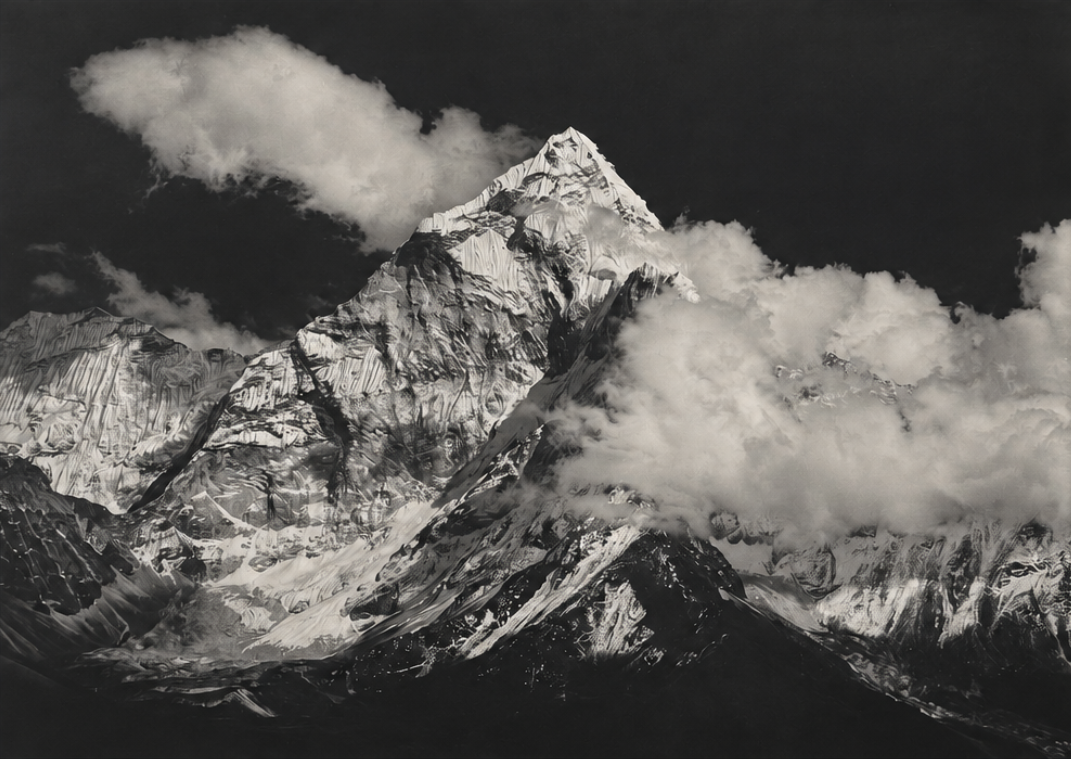
The Marriage of Physics and Metaphysics
Jeff Botz
BLACK & WHITE PHOTOGRAPHY
24" × 30"
$2,550
A monumental mountain landscape exploring the relationship between the physical world and the sublime.
THE ARTIST
Snow,
stone and
sky.
Jeff Botz has spent decades photographing the high Himalayas, creating a body of work shaped by endurance, large-format technique and a deep belief in the expressive power of black-and-white photography.
His relationship with the Himalayas began in 1972 during a brief trip to Kathmandu, where he photographed with 35 mm Kodachrome.
That same year, an encounter with Ansel Adams' work at the Witkin Gallery in New York transformed his understanding of what a photograph could achieve.
Over time, Botz moved away from color and small-format photography toward black-and-white large-format work capable of expressing the monumental scale of the mountains.
PHOTOGRAPHY
“Photography is philosophy.”
ANSEL ADAMS
A photograph
could be
powerful.
In 1972, Botz encountered Ansel Adams' Clearing Winter Storm, Yosemite National Park at the Witkin Gallery in New York.
The experience fundamentally changed his expectations of photography and began a lifelong commitment to technical precision and expressive printmaking.
In 1974, Botz purchased five framed Adams photographs. Their eventual sale helped finance his own photographic work and expeditions.
Years later, he would adopt the silver gelatin printing methods outlined by Adams, applying them to a landscape of very different scale and geography.
LARGE FORMAT
8 × 10
at the edge
of the world.
By 1998, Botz had committed to photographing the Everest region with a hand-built 8 × 10 inch view camera.
The camera, lenses, film, tripod and equipment weighed nearly sixty pounds, yet offered the resolution and tonal depth he felt the Himalayan landscape demanded.
On that expedition, Botz exposed 61 sheets of film. Sixty were fogged during development. One survived perfectly.
That single image confirmed for him that the technical difficulty was worth pursuing.
EVEREST
Epic scale,
absolute
precision.
From 1999 through 2019, Botz returned repeatedly to the Everest region, building an extensive photographic survey of the world's highest mountain and its surroundings.
His work is distinguished by the rare use of an 8 × 10 view camera in extreme alpine conditions.
On May 9, 2012, he deployed the camera at 21,854 feet on Mount Everest — described in his biography as the highest recorded deployment of such a camera.
The resulting photographs reduce the landscape to elemental relationships between snow, stone, atmosphere and light.
THE DARKROOM
The image
is finished
by hand.
Botz moved to North Carolina in 1996, establishing a home and darkroom near Marshville.
There, he continues to make silver gelatin prints using a large enlarger housed in a converted stable attached to his farmhouse.
His printing process is exacting. He has described making the same photograph repeatedly until the tonal relationships satisfy him.
The print is not simply a reproduction of the negative, but the final stage of the photographic act.
SELECTED WORKS
The Collection
EXHIBITIONS
Selected Institutions
One-person exhibition.
One-person exhibition, Kathmandu, Nepal.
Group exhibition and works in the museum collection.
Work held in the permanent collection at NC State.
PUBLICATIONS
Books
Portrait of Everest
Everest Not Everest
PHILOSOPHY
Beyond the
informative
sublime.
Botz describes photography as an expression of deeply held philosophical beliefs rather than simply a means of recording appearances.
His Himalayan photographs seek something universal in the austere forms of snow, stone and sky.
The scale of the landscape may be monumental, but the photographs remain disciplined: carefully composed, technically demanding and reduced to essential visual relationships.
COLLECT